



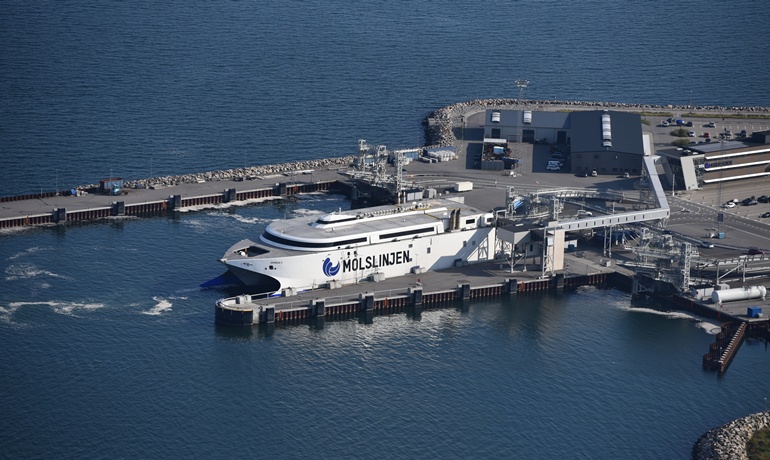
EXPRESS 3
Molslinjen's Kattegat service transported more cars with fewer ferries
High-speedThe ferry year 2025 meant more cars than ever on Molslinjen's ferries on the Kattegat. This is despite a year with one less ferry than before and thus also fewer departures.
When Molslinjen sold the ferry MAX to Seajets shortly before the 2024 high season, it meant one less ferry in the fleet of fast ferries on the Kattegat. Three ferries instead of four resulted in fewer departures.
The three remaining fast ferries on the Kattegat managed to send a historically high number of cars between Jutland and Zealand last year.
1,362,835 cars were transported in 2025 compared to 1,335,919 the year before. This is an increase of two percent – and slightly better than in 2019 when 1,351,588 cars were on the then four ferries.
"We have succeeded in creating a sailing schedule that suits our customers' travel needs, and we have simply become better at utilizing the space on board, so we can do more with less," says Molslinjen's CEO, Kristian Durhuus.
The number of passengers in 2025 ended at 3,330,703, better than 2024 with 3,305,298 passengers – but not quite on par with the record year 2019, when the ferries carried 3,492,698 passengers.
"We can feel that we are regaining the momentum that we lost during the corona years. It has also become a competitive advantage for us that the many new electric car owners can see the advantage in saving kilometers and thus electricity by taking the ferry," explains Kristian Durhuus.
On the ferries, approximately 29.5 percent of the transferred cars were an electric car in 2025 – significantly more than the total share of electric cars in the Danish car fleet, which today amounts to 17-18 percent.
© Shippax
jan 09 2026

Related articles
Most read
Stena Line confirms purchase of SOMERSET for Birkenhead–Dublin
okt 15 2026

Stena Line buys the SOMERSET for the Birkenhead – Dublin route
okt 12 2026
Oldest ferry in GNV’s fleet sold for recycling
okt 15 2026
DFDS’ new Baltic charter vessel leaves the Mediterranean
okt 16 2026
Baleària to refurbish three ferries to improve comfort and onboard services
okt 19 2026
Steam Packet Company provides update on progress and costs of repairs to MANXMAN
okt 11 2026
World’s Largest wind-propelled RoRo now fitted with rotor sails
okt 15 2026
Stora Enso signs up for Finnlines’ Green Lane low-carbon service
okt 15 2026

Products