



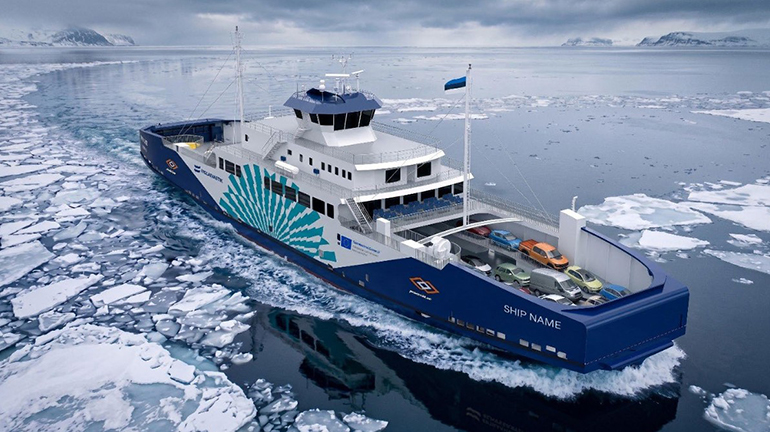
Rendering of newbuilding for Estonian State Fleet. © Crist S.A.
First electric ferry in Estonia to feature contra-rotating propeller units
FerryFinnish marine propulsion specialist Steerprop will supply the latest version of its contra-rotating propeller (CRP) technology to a fully electric ferry being built by Polish shipyard Crist S.A. for the Estonian State Fleet.
The vessel, described as Estonia’s first fully electric passenger ferry, will be propelled by two Steerprop SP 25 CRP units featuring permanent magnet motor drives. The ferry will also be the first to feature next generation of CRP technology, which further improves mechanical efficiency while delivering the excellent thrust in ice and open water for which the long-established CRP range is known. Steerprop states this in a press release.
Steerprop’s propulsion was selected for the project due to its ability to provide high thrust in ice, wind and open water conditions even with tight constraints on propeller diameter. The configuration of the push and pull propellers on Steerprop CRP’s single shaftline mean that it can achieve higher thrust and efficiency than similarly sized single-propeller units – or similar thrust using less power, helping to reduce installed power, energy use and emissions.
The next generation of CRP introduces pressure lubrication as standard for smaller CRP applications. By removing immersion lubrication, mechanical losses are reduced, enabling an increase of around 3.5% in mechanical efficiency alongside improved fuel economy and performance. As with all CRP units, the next-generation propulsors are hydrodynamically optimized and can be deployed as part of diesel, hybrid or pure-electric drive chains.
The 95-metre-long ferry, designed by LMG Marin, will use renewable shore power, with electricity stored in a 3MWh battery system, alongside auxiliary biodiesel generators for severe weather and emergency operations. The ferry will be classed to 1B Ice Class, enabling operation in ice of up to 60cm thick.
Steerprop's propulsion equipment is scheduled for delivery in late 2027, with the vessel expected to enter operation in late 2028. The total value of the design and construction contract is EUR 49.93 million. The project is co-funded by the European Union Modernisation Fund (EUR 28 million) and Estonia’s CO2 quota trading mechanisms.
Read also: Estonian State Fleet signs contract with CRIST S.A. to build Estonia’s first fully electric ferry
© Shippax
okt 16 2026

Related articles
Most read
Dieppe–Newhaven route put out to tender for new five-year concession
okt 08 2026
Stena Line to deploy two of its own RoRo vessels between Rotterdam and Harwich
okt 06 2026
Gibraltar acquisition finally approved – but DFDS withdraws from Ceuta opportunity
okt 08 2026
MARHABA SEAWAYS joins DFDS fleet
okt 08 2026
Stena Line buys the SOMERSET for the Birkenhead – Dublin route
okt 12 2026
Stena Line confirms purchase of SOMERSET for Birkenhead–Dublin
okt 15 2026
MAXINE chartered by Smyril Line
okt 08 2026

Stena Line’s Port of Gothenburg terminal relocation one step closer
okt 07 2026

Products