



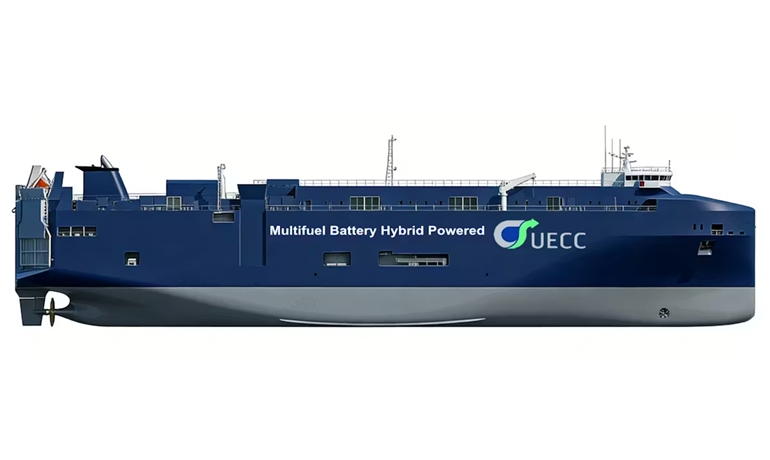
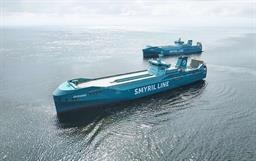
Illustration © UECC
UECC expands fleet with order for two 3,000 CEU multi-fuel battery hybrid PCTCs
Ro-roUnited European Car Carriers (UECC) is further expanding its fleet of PCTCs with the order of two additional multi-fuel battery hybrid newbuilds at a Chinese shipyard that will boost its cargo-carrying capacity and flexibility in the European short sea trade.
The latest newbuilding contract is for a pair of 3,000 CEU-capacity PCTCs to be constructed at China Merchants Jinling Shipyard Nanjing where UECC already has on order two larger 4500 CEU units with similar specifications that are due for delivery in 2028.
The latest newbuildings, developed in close cooperation with Shanghai Ship Research & Design Institute (SDARI), will incorporate multi-fuel LNG-driven engines with state-of-the-art propulsion technologies to optimize energy efficiency and an aerodynamic hull design to minimize fuel consumption and they will have shore power capability.
Enhanced safety management
“Pioneering design, innovative thinking and future-proofing are at the core of our sustainable newbuilding strategy,” said UECC’s CEO Glenn Edvardsen.
He said, “safety has been a defining priority in the vessel’s development”, underpinned by a robust safety architecture that strengthens fire containment and integrates enhanced monitoring, detection and response capabilities to support safe transport of demanding cargo, including dangerous goods.
“The design is intended not only to meet current regulatory requirements, but also to address evolving fire-risk profiles and align with the direction of future safety standards,” Edvardsen explained.
Ballast-free design and wider cargo scope
The vessels, scheduled for delivery early in 2028, will feature an essentially ballast-free design that supports exceptionally low fuel consumption and will also be equipped with real-time emissions monitoring capabilities, supporting increased transparency and continuous insight into environmental performance, he explained.
They will incorporate nine decks with a quarter stern ramp capacity of 160 tonnes and LOA of 169.5m, giving the PCTCs flexibility to handle a range of vehicles, high & heavy (H&H) and other rolling cargoes on UECC’s European short sea shipping liner network where they will be deployed.
With a deck configuration and a main deck that is market leading in terms height combined with increased deck strength, enabling the transport of substantially larger H&H units and project cargo than is typically possible for a PCTC, positioning the vessel to capture cargo traditionally outside the segment’s reach.
Digital solutions
The newbuild PCTCs will also be supported by an integrated digital framework designed to enhance operational insight and decision-making.
“Advanced monitoring and data capabilities contribute to improved performance management, situational awareness and lifecycle optimisation. Together, these digital solutions support safer, more efficient and transparent operations across the vessels’ service life,” Edvardsen said.
With four newbuilds now on order, UECC will ultimately have a total of nine dual-fuel LNG and multi-fuel battery hybrid PCTCs – delivered from 2016 onwards – that are capable of running on liquefied biomethane (LBM). The latest newbuilds are also designed with adaptability to accommodate future technological innovations and new alternative fuels as these become available, according to Edvardsen.
Exceeding regulations
Vehicle manufacturers have been able to achieve major savings in Scope 3 emissions through participation in UECC’s Sail for Change initiative, in which LBM (or bioLNG) is being bunkered on its PCTC fleet.
With the use of biofuels on its other vessels, UECC is able to run a compliance surplus under FuelEU Maritime, while minimizing exposure to the EU Emissions Trading System.
“We are making another major investment in vessel capacity in response to increasing demand for sustainable, efficient and flexible marine transport, reinforcing our commitment to operate one of the most advanced and eco-friendly fleets in this segment to enhance environmental performance for the benefit of our customers,” Edvardsen said.
“With our innovative fleet renewal program, we are realizing our ambitious environmental goals while taking a leading role in decarbonization of shipping,” he concluded.
© Shippax
mar 04 2026

Related articles
Most read
Stena Line confirms purchase of SOMERSET for Birkenhead–Dublin
okt 15 2026
Stena Line buys the SOMERSET for the Birkenhead – Dublin route
okt 12 2026
Oldest ferry in GNV’s fleet sold for recycling
okt 15 2026
DFDS’ new Baltic charter vessel leaves the Mediterranean
okt 16 2026
Baleària to refurbish three ferries to improve comfort and onboard services
okt 19 2026
World’s Largest wind-propelled RoRo now fitted with rotor sails
okt 15 2026
Steam Packet Company provides update on progress and costs of repairs to MANXMAN
okt 11 2026
Stora Enso signs up for Finnlines’ Green Lane low-carbon service
okt 15 2026
Products