


BOS Power to supply shoreside batteries for Molslinjen's Kattegat electrification
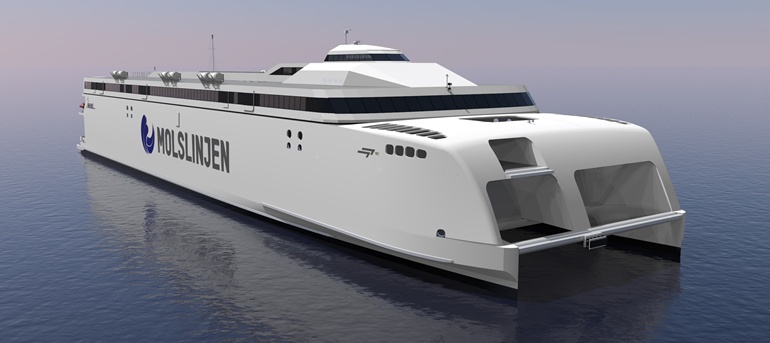
High-speedMolslinjen has selected Nordic energy storage specialist BOS Power to deliver the two large shoreside battery packs that will power its forthcoming electric high-speed ferries on the Kattegat route between Jutland and Zealand.
BOS Power has been awarded a turnkey Battery Energy Storage System (BESS) contract covering two coastal sites, in the harbours of Aarhus and on Sjællands Odde. Each battery pack will have a capacity of 118 MWh and will ensure the large catamarans can recharge every time they berth at one of the two ports. The contract adds almost 250 MWh of energy storage to BOS Power's Nordic portfolio, which now exceeds 500 MWh of delivered and contracted capacity, and ranks among the largest energy storage projects in the company's history.
The shoreside installations complement substantial battery capacity carried aboard the vessels themselves. Each of the three catamarans is fitted with 44.75 MWh of installed batteries, giving some 134 MWh across the trio. Together with the two 118 MWh harbour packs, the project will comprise roughly 370 MWh of battery storage in total, underlining the scale of what Molslinjen describes as the world's largest maritime electrification project.
Charging will take place over roughly half an hour using a combination of grid power and the harbour batteries. When a single catamaran connects to the charging point, the vessel will charge at 15 kV AC and 55,000 kW for 30 minutes, equivalent to an average of 25,000 kWh of energy received before the next crossing. The onshore batteries provide backup and redundancy, storing the equivalent of three to four ferry crossings should grid supply falter.
"We cannot simply charge directly from the supply grid on every crossing. To be certain of always having the necessary energy available, we need the batteries for backup and redundancy," said Carsten Jensen, CEO of Molslinjen. Hans-Henrik Simonsen, Technical Director at Molslinjen, added that the large onshore battery systems will be central to the transition of the high-speed ferries to electric operation.
BOS Power will act as full EPC contractor and turnkey system integrator across both sites, carrying the complete scope under a single point of responsibility, from design, engineering and permitting through civil works, mechanical and electrical installation, commissioning and grid code compliance. The integration of both installations directly into the port and charging infrastructure makes the project one of the more technically demanding BESS deployments in the Nordic region.
"This ferry route is critical infrastructure. The Kattegat connection between Jutland and Zealand is a lifeline for the people and goods that rely on it every day, and electrifying the ferries that serve it has to be done without compromising that reliability," said Kim Strate Kiegstad, Head of Energy Storage at BOS Power. The work has been carried out in cooperation with experts from Hybrid Greentech, which has advised Molslinjen since the project began.
The three battery-powered catamarans are currently under construction at the Incat yard in Australia, with the first ferry scheduled to enter service in spring 2028. Once all three vessels are in operation, the project is said to save 132,000 tonnes of CO2 each year. The ferries and associated onshore infrastructure carry a total cost of DKK 3.5 billion, while the parties have agreed not to disclose the price of the two battery packs.
© Shippax
jun 29 2026

Related articles
Most read

Fire on board RoRo BLUE CARRIER 2 north of Mykonos, all 29 evacuated safely
sep 25 2026
Viking Line and FlixBus launch combined sea and coach travel
sep 29 2026
Dieppe–Newhaven route put out to tender for new five-year concession
okt 08 2026
BC Ferries three former PacifiCat fast ferries being broken up/recycled in Egypt
okt 01 2026
Brittany Ferries move BARFLEUR to Rosslare-Cherbourg
okt 01 2026
Stena Line to deploy two of its own RoRo vessels between Rotterdam and Harwich
okt 06 2026
MED STAR could be heading to Creta Cargo Lines
sep 30 2026
Molslinjen takes over Koster Islands ferry service in Sweden
sep 25 2026
Products