



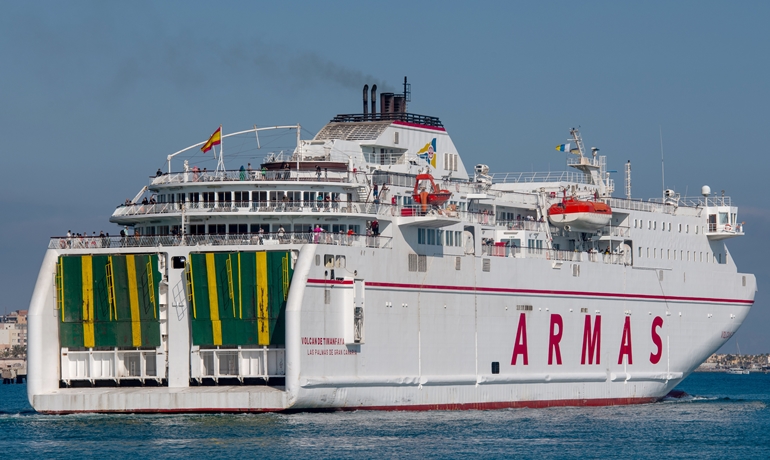
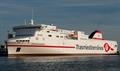
VOLCÁN DE TIMANFAYA will become the most modern addtion of the four © Frank Lose
Baleària completes Armas Trasmediterránea takeover with Strait and Alborán assets
FerryBaleària has closed the acquisition of the Alborán and Strait perimeters of Naviera Armas Trasmediterránea, adding four vessels and a portfolio of route concessions after clearing the competition authorities in both Spain and Morocco.
The deal completes the transaction first announced in August 2025, which had already seen the Canary Islands perimeter close in May under the Baleària Canarias brand. With the latest closing, the Dénia-based operator takes full legal and operational control of the Armas Trasmediterránea assets in the two remaining areas.
The Alborán perimeter brings three ships into the Grupo Baleària fleet: JUAN J SISTER, ALMARIYA and VOLCÁN DE TIMANFAYA. The Strait perimeter adds a range of concessions together with the ferry CIUDAD DE MÁLAGA. Around 250 employees transfer to Baleària under the two operations, whose jobs the company says are maintained and guaranteed.
Of the four vessels, VOLCÁN DE TIMANFAYA is the most modern, a 17,343 GT RoPax built by Hijos de J. Barreras, Vigo, in 2005, with capacity for 1,000 passengers and 1,350 lane metres at a service speed of 23 knots. JUAN J SISTER, a 22,409 GT unit delivered by MASA-Yards in 1993, offers 1,290 lane metres and accommodation for 806 passengers. ALMARIYA, the oldest of the group at 21,473 GT, was built by AG Weser in 1981 and carries up to 1,865 passengers. The smallest, CIUDAD DE MÁLAGA, is an 8,845 GT vessel completed at Astilleros de Huelva in 1998 with 636 lane metres and berths for 943 passengers.
Baleària president Adolfo Utor described the transaction as a strategic step that consolidates a long-term business project drawing together significant strands of Spanish shipping. He said the company was taking on the growth as the leading nationally owned ferry operator, present across every domestic cabotage connection and able to guarantee the strategic, essential character of maritime links for the country's territorial cohesion.
Utor added that Baleària would respond with reliability, innovation and stability for users, hauliers, staff and territories, as it is already doing in the Canaries. The company plans to invest in and adapt the acquired fleet to the parent group's quality standards, reinforcing crews and optimising operations through a fleet investment and improvement programme aimed at enhancing service quality, the passenger experience, environmental sustainability and corporate culture.
The Comisión Nacional de los Mercados y la Competencia (CNMC) cleared the Strait operation in March and the Alborán operation in May, while the Moroccan competition authority approved both perimeters last week. The closing comes a month after Baleària took effective control of operations in the Canary archipelago, where a three-year, EUR 45 million investment plan is already under way covering vessel modernisation, the introduction of four new ships and crew reinforcement.
Following the transaction, the enlarged group has close to 4,500 employees and a fleet of more than 50 ships. Combined annual traffic is expected to exceed eight million passengers and 11 million lane metres of freight this year, generating consolidated turnover of more than EUR 1,000 million.
© Shippax
jul 02 2026

Related articles

Most read

Stena Line confirms purchase of SOMERSET for Birkenhead–Dublin
okt 15 2026

Stena Line buys the SOMERSET for the Birkenhead – Dublin route
okt 12 2026

Oldest ferry in GNV’s fleet sold for recycling
okt 15 2026
DFDS’ new Baltic charter vessel leaves the Mediterranean
okt 16 2026

Baleària to refurbish three ferries to improve comfort and onboard services
okt 19 2026

World’s Largest wind-propelled RoRo now fitted with rotor sails
okt 15 2026

Steam Packet Company provides update on progress and costs of repairs to MANXMAN
okt 11 2026

Stora Enso signs up for Finnlines’ Green Lane low-carbon service
okt 15 2026

Products