



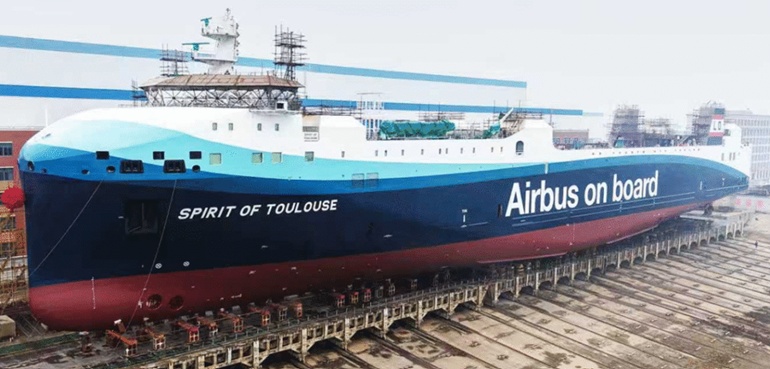
SPIRIT OF TOULOUSE
First of three new purpose-built RoRo’s for Airbus was launched
Ro-roLD Armateurs is set to welcome the first ship of its next generation RoRo vessels chartered to Airbus. The SPIRIT OF TOULOUSE was launched in the start of February at Wuchang Shipyard (CSSC Group). Two other vessels – SPIRIT OF MOBILE and SPIRIT OF MIRABEL - are under construction.
The new low-emission vessels, which will be used to ship aircraft components for Airbus, will each be powered by a combination of six 35-metre tall Norsepower Rotor Sails and two dual-fuel engines capable of running on e-/bio-methanol or marine diesel oil.
From the outset, these vessels have been designed to minimize CO2 emissions, employing a holistic approach. They include efficient propellers and shafts produced from recycled steel, very low-friction anti-fouling coatings, a smart power management system, and a heat conversion system.
Equipped with routing software to optimize their routes, they will be able to maximize wind propulsion and minimize drag from adverse ocean conditions. This is further improved using an advanced AI-powered control solution which enables the vessels to adapt to changing external weather and sea conditions and achieve vessel-specific aerodynamic optimization.
Together, these innovations will result in state-of-the-art vessels that combine cutting-edge technology to achieve ambitious environmental goals. Each vessel in the new fleet is expected to deliver a 70% decrease in CO2 emissions, on a yearly basis, compared with the previous generation of ships.
LDA currently operates two vessels on the transatlantic route for Airbus, including the VILLE DE BORDEAUX, the largest of the fleet, with a cargo capacity equivalent to six aircraft. The new vessels - SPIRIT OF TOULOUSE, SPIRIT OF MOBILE and SPIRIT OF MIRABEL - will match this cargo capacity.
Further emission reductions could be achieved using low-carbon alternative fuels, such as hydrotreated vegetable oil (HVO) or e-methanol. At fleet level, considering an increase in overall capacity, the introduction of the new 168 metre long and 23,3-metre-wide vessels is expected to reduce average annual transatlantic CO2 emissions by approximately 50% compared with 2023, while supporting higher transport volumes. The vessels service speed will be 14 knots.
© Shippax
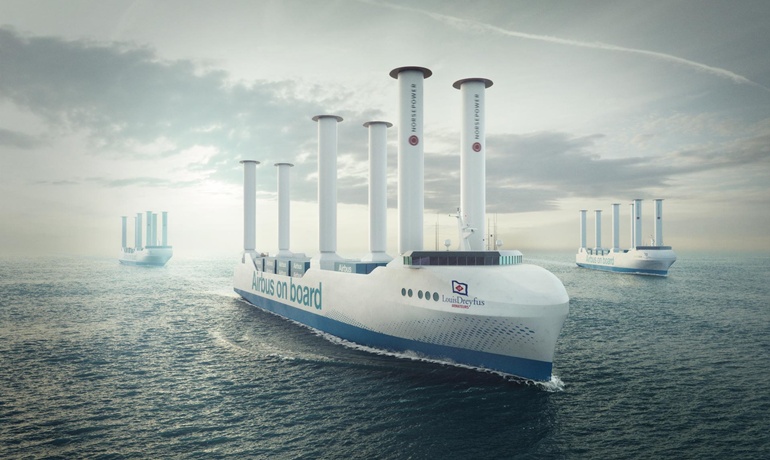
Illustration of how they will look once completed
feb 10 2026

Related articles
Most read
Dieppe–Newhaven route put out to tender for new five-year concession
okt 08 2026
Stena Line to deploy two of its own RoRo vessels between Rotterdam and Harwich
okt 06 2026
Brittany Ferries move BARFLEUR to Rosslare-Cherbourg
okt 01 2026
BC Ferries three former PacifiCat fast ferries being broken up/recycled in Egypt
okt 01 2026
Gibraltar acquisition finally approved – but DFDS withdraws from Ceuta opportunity
okt 08 2026
MARHABA SEAWAYS joins DFDS fleet
okt 08 2026

Stena Line buys the SOMERSET for the Birkenhead – Dublin route
okt 12 2026
MAXINE chartered by Smyril Line
okt 08 2026

Products