



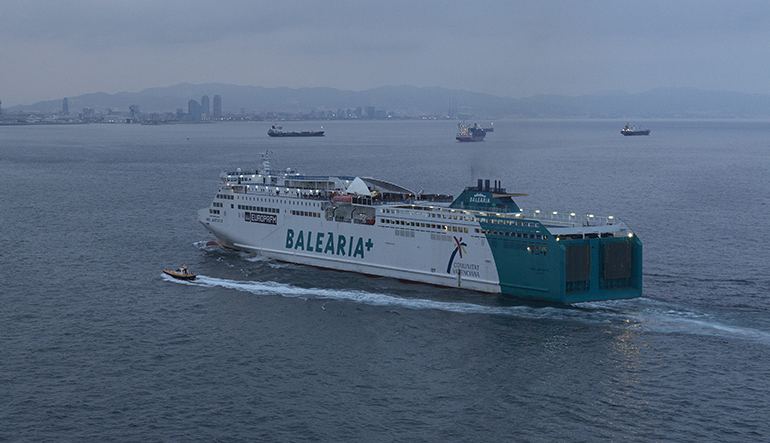
A Balearia RoPax ferry off Barcelona. © Søren Lund Hviid
Spain’s RoRo sector loses capacity and routes as demand weakens
Ro-roSpain’s international RoRo shortsea shipping traffic, excluding vehicles carried as cargo, fell by 1.2% to 13.3 million tonnes in the first half of 2026, according to SPC Spain (Spanish Shortsea Promotion Center).
Traffic on the Atlantic coast declined by 4.8%, while Mediterranean traffic remained broadly stable, falling by 0.7%. The sharpest declines were recorded in Atlantic traffic with Belgium, down 20.7%, the United Kingdom, down 10.4%, and Ireland, down 6.0%. Traffic with the Netherlands increased by 564% following the opening of a route to Vilagarcía de Arousa. On the Mediterranean coast, traffic with Morocco fell by 2.3%, while Italy recorded growth of 1.3%.
International shipments of vehicles carried as cargo decreased by 2.7% to 696,000 vehicles, equivalent to 1.6 million tonnes. Outbound shipments fell by 8.7%, while inbound shipments increased by 11.1%.
RoRo capacity offered as an alternative to road transport fell by 7.3%, with reductions of 8.8% on the Atlantic coast and 6.5% on the Mediterranean.
By September, Spain had lost three Motorways of the Sea routes, leaving two Atlantic and five Mediterranean services. Capacity on these routes declined by 20% and 7.9% respectively.
The capacity reductions pushed estimated utilisation to 80%, compared with 68.3% in 2025. RoRo shortsea shipping accounted for 10.7% of combined international road and short sea transport demand.
SPC Spain warns that declining capacity and fewer routes could weaken maritime transport’s contribution to decarbonisation and easing road congestion. The association argues that higher costs and mounting environmental requirements are encouraging traffic to shift to roads and calls for maritime competitiveness to be considered in the transition towards more sustainable transport.
© Shippax
okt 07 2026

Related articles




Most read

Fire on board RoRo BLUE CARRIER 2 north of Mykonos, all 29 evacuated safely
sep 25 2026

Stena Line orders two new hybrid ferries for the Sweden - Denmark route
sep 23 2026

ANALYSIS: Stena’s historic home route finally gets its fifth-generation newbuilds
sep 24 2026

Viking Line and FlixBus launch combined sea and coach travel
sep 29 2026

Stena RoRo designates new Kattegat ferries as E-Flexer 2.0
sep 24 2026

BC Ferries three former PacifiCat fast ferries being broken up/recycled in Egypt
okt 01 2026

Brittany Ferries move BARFLEUR to Rosslare-Cherbourg
okt 01 2026
MED STAR could be heading to Creta Cargo Lines
sep 30 2026

Products