



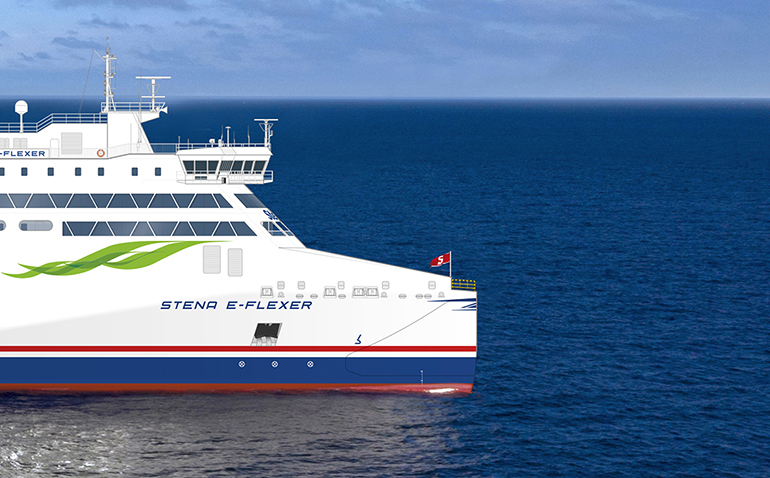
The 16th and 17th E-Flexers introduce, among other things, a new bow and superstructure. © Stena Line
ANALYSIS: Stena’s historic home route finally gets its fifth-generation newbuilds
FerryLane metre capacity on Stena Line’s Gothenburg–Frederikshavn route will rise by 45% when the operator introduces two new RoPax ferries in 2030. At the same time, the route will become more freight oriented, as its total passenger capacity will fall by 35%. Stena Line is currently the sole operator between Sweden and Denmark across the Kattegat with only this route, following the closure of its southern Kattegat route between Halmstad and Grenaa in April.
Assuming no competing service is launched across the Kattegat before 2030 to fill the gap left by that closure, the fleet renewal on the northern route will give Stena Line – as the only operator - an 11% increase in the total lane metre capacity on the Kattegat market, despite the closure of the Halmstad–Grenaa route.
The announcement on 23 September of an order for two RoPax ferries from China Merchants Industry Weihai Shipyard in China marks the fifth generation of ferries for the Gothenburg-Frederikshavn route. Each will have capacity for 2,720 lane metres and 1,400 passengers. Gothenburg-Frederikshavn is Stena Line’s oldest and longest-running car and passenger ferry route. It can be described as the birthplace of the Stena Line whose network today stretches from the Irish Sea in the west, through routes between southern England and the Netherlands and across the Kattegat, to both north-south and east-west corridors in the Baltic Sea.
The Gothenburg-Frederikshavn route received its first purpose-built car and passenger ferry, STENA DANICA (I), in 1965. The two ferries that the newbuildings are apparently expected to replace in 2030 are the 1983-built STENA DANICA (IV) and the 1996-built STENA JUTLANDICA (III). Both were also built for the route. Despite its place in the company’s history, Gothenburg-Frederikshavn now has the highest average vessel age of any Stena Line route. When STENA DANICA (IV) is replaced in 2030, it will be 47 years old and will have served longer on a single route than any other large RoPax ferry in Europe.
The 16th and 17th E-Flexers
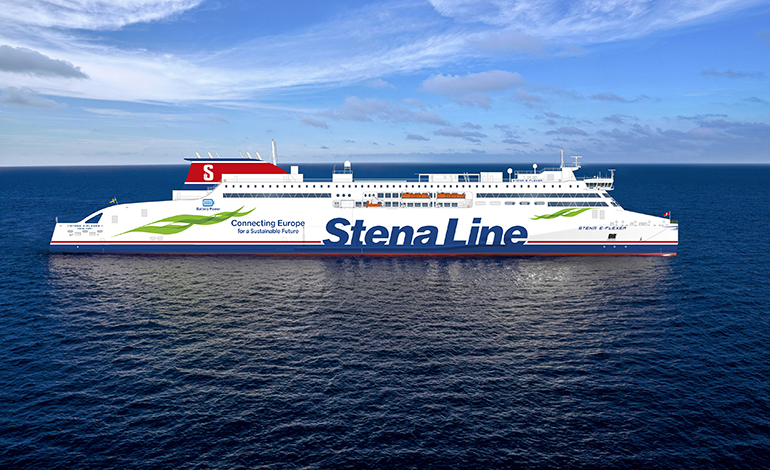
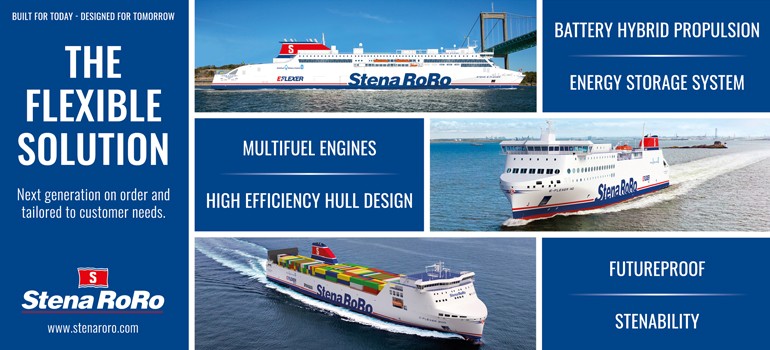
Stena Line’s two new Kattegat ferries are based on Stena RoRo’s highly successful E-Flexer design. With these newbuildings, the platform now accounts for 17 delivered or contracted vessels. They will be the sixth and seventh E-Flexers built for use within the Stena Group. Stena Line already operates STENA ESTRID (2019), STENA EDDA (2020), STENA EMBLA (2020), STENA ESTELLE (2022) and STENA EBBA (2022). All vessels based on the E-Flexer platform have a beam of 27.8 metres.
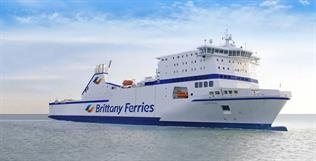
So far, the platform has been produced in seven length variants. Stena Line says the two new Gothenburg-Frederikshavn ferries will have an overall length of 214.5 metres. This is the same length as Stena Line’s three E-Flexers delivered in 2019–2020 for its Irish Sea services, and three other vessels operated by Brittany Ferries and DFDS. However, it appears that Stena RoRo has modified the bow on the 16th and 17th vessels to a vertical axe-bow form, probably with an integrated bulb, while also softening the side profile with a new, more streamlined forward section of the superstructure. The two new ferries will be built primarily for day crossings, although they will have a small number of cabins. The only other E-Flexer built as a day ferry is DFDS’s COTE D’OPALE (2021), which operates between Dover and Calais.
Stena Electra vision now sidelined
Over the past decade, Stena Line has occasionally published variations and updates to its “Stena Electra” concept project. It has always centred on the company’s home route, Gothenburg-Frederikshavn, and has envisaged first fully electric propulsion and later a battery hybrid arrangement that also included hydrogen fuel cells. The aim throughout has been to visualise a future zero-emission vessel concept for introduction on the route in 2030. The battery capacity envisaged for Stena Electra has been 60-70 MWh. The project has now probably been sidelined by the success of the E-Flexer design, which appears capable of delivering much the same result through a more conventional approach.
For now, Stena Line has said only that the two newbuildings will be equipped with the latest hybrid technology and prepared for fully electric operation in the future, once sufficient shoreside charging infrastructure is available. Stena RoRo confirmed to Shippax last year that rapid improvements in the energy density of maritime battery packs could soon make it possible to increase the current maximum E-Flexer battery capacity of 12 MWh tenfold without compromising the vessels’ commercial loading capacity. The two E-Flexers with the largest battery installations to date, at 12 MWh each, are Brittany Ferries’ SAINT-MALO (2024) and GUILLAUME DE NORMANDIE (2025). This article has been updated since publication with revised figures provided by Stena RoRo.
Read also: Stena Line orders two new hybrid ferries for the Sweden - Denmark route
© Shippax/SLH
© Stena Line
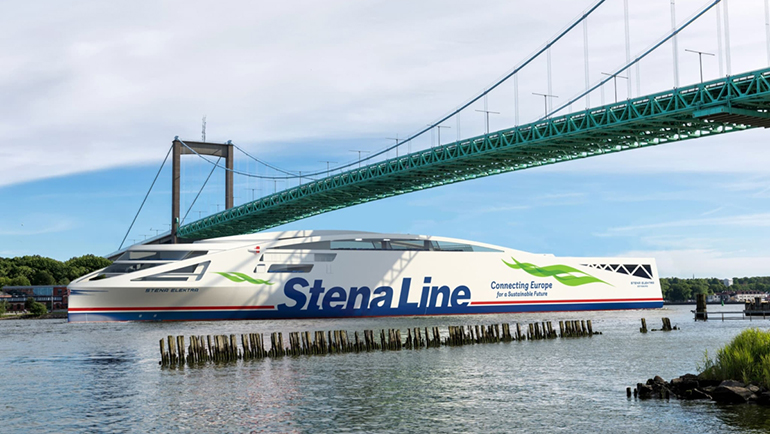
One of the latest renderings of the Stena Electra project. © Stena Line
sep 24 2026

Related articles
Most read
Dieppe–Newhaven route put out to tender for new five-year concession
okt 08 2026
Stena Line confirms purchase of SOMERSET for Birkenhead–Dublin
okt 15 2026
Gibraltar acquisition finally approved – but DFDS withdraws from Ceuta opportunity
okt 08 2026
MARHABA SEAWAYS joins DFDS fleet
okt 08 2026

Stena Line buys the SOMERSET for the Birkenhead – Dublin route
okt 12 2026

Oldest ferry in GNV’s fleet sold for recycling
okt 15 2026

MAXINE chartered by Smyril Line
okt 08 2026
DFDS’ new Baltic charter vessel leaves the Mediterranean
okt 16 2026

Products