


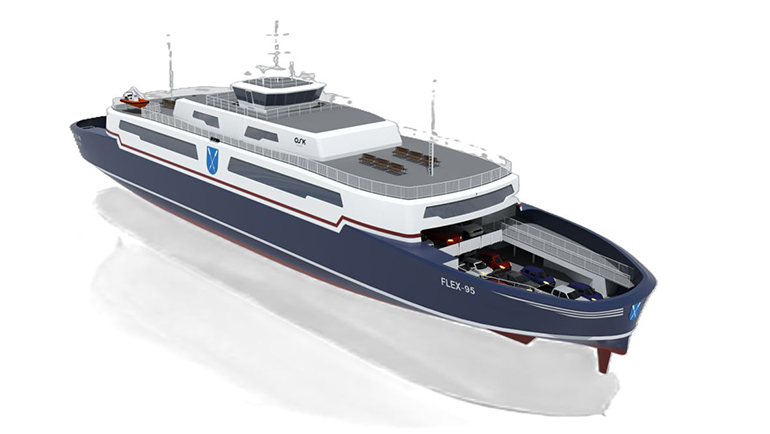
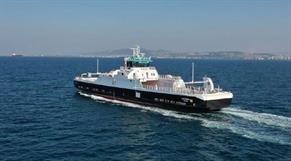
The (95-metres LOA) Samsø version of the LightCraftOSK ferry design. © OSK Design
New ferry design could pave the way for significantly lower CO2 emissions
FerryFollowing several years of development work, OSK Design, the two small Danish island municipalities of Samsø and Ærø, and Bureau Veritas have received important regulatory clarification that could pave the way for a new generation of energy-efficient, zero-emission ferries.
The Danish Maritime Authority has informed the project partners that the new LightCraftOSK ferry design project can proceed under national regulations, provided the ferries meet the required safety standards.
This marks an important milestone in the development of future ferries. The clarification opens the door to a different approach to ferry design, using low weight to reduce energy consumption without compromising safety.
The LightCraftOSK concept has been developed by OSK Design in close collaboration with the municipal ferry operators Samsø Rederi and Ærøfærgerne, and Bureau Veritas. A lighter aluminium hull can significantly reduce energy consumption compared with a traditional steel ferry design.
The lower energy requirement also makes full electrification much more feasible and could therefore lead to a substantial reduction in CO2 emissions.
The concept has been developed for Samsø Rederi’s Hou–Sælvig route and Ærøfærgerne’s route between Ærøskøbing and Svendborg. In the longer term, the design principles could be applied to similar domestic routes.
Following discussions between the project partners, the Danish Maritime Authority and the European Commission, the Danish Maritime Authority has confirmed that the vessels will fall outside the scope of the EU Passenger Ship Directive and can instead be approved under national regulations for smaller passenger ships operating on domestic services.
The requirements of the HSC Code may be applied as an alternative to the standard national requirements, provided an individual risk assessment demonstrates that the ferries achieve an equivalent level of safety.
This clarification is precisely what makes the project interesting: safety remains the deciding factor, while the ferry design itself can be rethought with a focus on lower weight, reduced energy consumption and electric propulsion.
The existing ferry on the Samsø route, the 2015-built LNG dual-fuel double-ended PRINSESSE ISABELLA, emits around 7,200 tonnes of CO2 annually, while the two ferries on the Ærø route, the 1999-built sisters MARSTAL and ÆRØSKØBING, together emit around 7,800 tonnes of CO2 a year. The ambition is for electrification, combined with lower energy consumption, to bring emissions from ferry operations themselves close to zero.
For OSK Design, the regulatory clarification is an important step towards realising the first designs based on the LightCraftOSK concept. Kristian Carøe Lind, Chief Design Officer at OSK Design, said:
“It is fantastic that we can now continue developing the FlexFerries according to the LightCraftOSK principles. The idea is simple: we want to give the ferries the capacity their routes require but build them significantly lighter. We save more than 30% in energy, substantially reducing the very high costs of charging infrastructure and the battery pack. Throughout the process, OSK has focused on optimising the municipalities’ costs across the entire value chain, from the electricity grid and the port to the ferry.”
“With this regulatory clarification, an important barrier has been removed. Work now continues to secure funding so that the ambition of a new generation of energy-efficient, zero-emission ferries can become a reality,” Kristian Carøe Lind concluded.
Shippax explored the LightCraftOSK project and its potential in depth in October 2024, when it was still at an early stage. Read the article online in Shippax Info, October 2024 (subscription required). Link
© Shippax
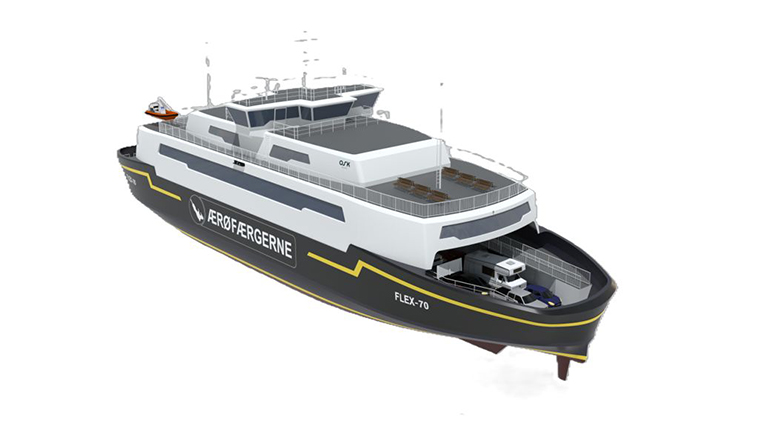
The (70-metres LOA) Ærø version of the LightCraftOSK ferry design. © OSK Design
okt 03 2026

Related articles
Most read
Stena Line confirms purchase of SOMERSET for Birkenhead–Dublin
okt 15 2026
Stena Line buys the SOMERSET for the Birkenhead – Dublin route
okt 12 2026
Oldest ferry in GNV’s fleet sold for recycling
okt 15 2026
DFDS’ new Baltic charter vessel leaves the Mediterranean
okt 16 2026
Baleària to refurbish three ferries to improve comfort and onboard services
okt 19 2026
Steam Packet Company provides update on progress and costs of repairs to MANXMAN
okt 11 2026
World’s Largest wind-propelled RoRo now fitted with rotor sails
okt 15 2026
Stora Enso signs up for Finnlines’ Green Lane low-carbon service
okt 15 2026
Products