



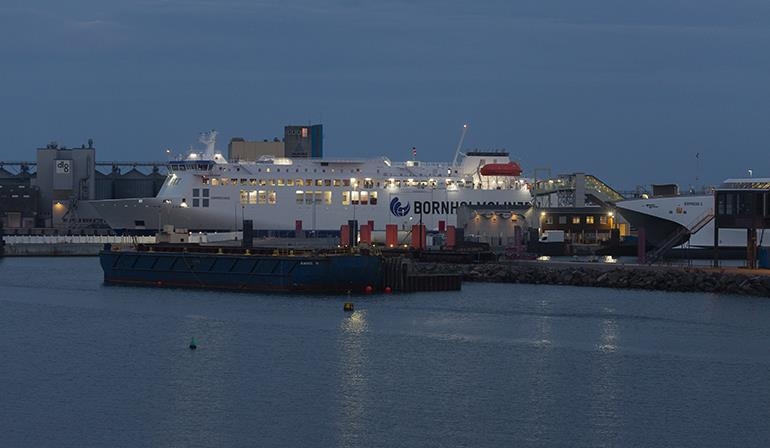
HAMMERSHUS has just arrived in Rønne after an overnight crossing from Køge. © Søren Lund Hviid
Major energy project adds to pressure on Bornholm’s RoPax capacity
FerryLocal hauliers on Bornholm fear that freight capacity on ferries to and from the island will come under further pressure in the coming years as construction begins on Bornholm Energy Island.
The joint Danish-German project, which will have up to 3.8 GW of offshore wind capacity, involves construction work both in the waters off Bornholm and on the island itself. The project is expected to enter service between 2034 and 2036.
Local hauliers warn that the work will put further strain on freight capacity on the ferry linking Bornholm with mainland Denmark, which is already stretched, TV2 Bornholm reports.
Bornholm has three ferry routes linking it with mainland Denmark, Sweden and Germany. All three are operated by Molslinjen under the Bornholmslinjen brand. The routes to Ystad in Sweden and Køge in Denmark are operated under a contract with the Danish state that runs until the end of August 2030, while the seasonal route to Sassnitz in Germany operates on a purely commercial basis.
The Ystad route relies mainly on high-speed ferries and caters primarily to passengers and private cars. The Køge route is served exclusively by RoPax tonnage and is the main freight corridor between Bornholm and the rest of Denmark for the island’s businesses.
When the contract began in 2018, Molslinjen introduced the purpose-built RoPax newbuild HAMMERSHUS, whose 1,500 lane metres of capacity exactly match the contractual requirement.
As Bornholm’s businesses have grown, that capacity has increasingly fallen short of demand. With a crossing time of five hours and 30 minutes, there is insufficient time to complete two round trips within 24 hours while allowing enough time for loading and unloading.
The local hauliers’ concerns are shared by Bornholm’s Traffic Council, which is involved in the tender process for the two contracted routes.
“Freight capacity is already under considerable pressure. With the energy island coming, that pressure is only going to increase,” Frederik Tolstrup, chair of the council and mayor of Bornholm Regional Municipality, told TV2 Bornholm.
Tolstrup is now opening talks with Denmark’s transport minister on behalf of Bornholm.
“One option would be for POVL ANKER to make an extra sailing when freight demand is high. That would be the simplest solution because POVL ANKER is already in port and serves as the reserve ferry,” he told the local broadcaster.
He also pointed to the possibility of carrying more freight on the high-speed ferries, an option currently available only outside the peak season.
The 1978-built, formerly state-owned overnight ferry POVL ANKER is also covered by the current contract as a reserve vessel, primarily to stand in for the high-speed ferries when weather conditions prevent them from sailing.
Work on the new contract for Bornholm’s ferry services is due to begin in 2027. The Danish Ministry of Transport will put the contract out to tender.
© Shippax
nov 13 2026

Related articles

Most read
CRACOVIA to be replaced by a larger vessel on Algerian service
nov 09 2026
Isle of Man puts purchase of MANANNAN replacement on hold until Douglas harbour is dredged
nov 09 2026

Tender on reinstatement of RoRo facilities at former ferry ports at either end of bridge
nov 02 2026
Philippine ferry capsizes right in front of its berth
okt 30 2026

ELPIS sold to cash buyer after unsuccessful attempts to scrap sister ship
nov 01 2026
GLEN ROSA’s expected delay now increases to eight years and seven months
okt 30 2026
Funding secured for BESS capacity in Igoumenitsa Port
nov 01 2026
ABB to power third Washington State Ferries hybrid-electric newbuild vessel
nov 01 2026