


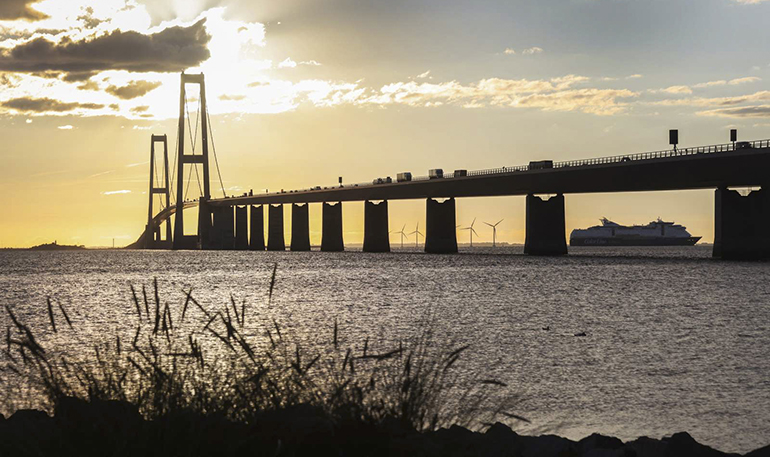
The Great Belt Bridge seen from the former car ferry port on the Zealand side. © Sund & Bælt
Tender out on reinstatement of RoRo facilities at former ferry ports at either end of the Great Belt Bridge
FerryDanish state-owned company A/S Storebælt, which owns the 18-kilometre combined bridge and tunnel link across the Great Belt, has issued an EU tender for the reinstatement of RoRo facilities at either end of the link.
The bridge and tunnel connection is now one of Denmark’s most important transport arteries, linking Zealand, including the capital region, with Funen and Jutland to the west, which together account for 53.4% of Denmark’s population.
The reinstatement of RoRo berths at the two former ferry ports, Halsskov on Zealand and Knudshoved on Funen, is intended to strengthen Denmark’s emergency preparedness, particularly in light of heightened geopolitical instability following Russia’s invasion of Ukraine.
Broadly, the tender covers restoring the two sites so that RoRo services can be brought into operation at four weeks’ notice if the fixed link is put out of action. The work therefore also includes establishing vehicle marshalling areas. Before the new port facilities can be built, some of the remaining structures at both ports must be removed, a task also included in the tender.
The two former ferry ports served the Great Belt car ferry route operated by the then state-owned DSB-Rederi and subsequently Scandlines. The service ceased in June 1998 with the opening of the road link across the Great Belt, comprising a low bridge and a high suspension bridge interconnected by the island Sprogø.
The previous year, the rail ferry route between Korsør on Zealand and Nyborg on Funen, which ran parallel to the car ferry route, had also been discontinued. This coincided with the opening of the rail link through the tunnel and across the low bridge.
Parts of the former ferry ports have since been sold to private owners, meaning that the reinstatement project also involves an expropriation process. Alongside the Great Belt fixed link, the other principal transport corridor for vehicles between Zealand and Jutland is Molslinjen’s high-capacity, high-speed ferry route between Sjællands Odde on Zealand and Aarhus, Denmark’s second-largest city, in Jutland.
Molslinjen operates this northern corridor on a fully commercial basis. Under the legislation that originally provided the basis for the Great Belt fixed link, however, the state would be obliged either to tender a ferry service north of the Great Belt or operate it itself if a commercial service were no longer maintained. The legislation also provides for a southern route, currently the Taars–Spodsbjerg service, which Molslinjen operates under a concession.
In a crisis, RoRo corridors between Zealand and Jutland could also be established to some extent using existing L-shaped berths suitable for RoRo operations at several ports on either side of the Kattegat, served by chartered RoRo tonnage.
More than 38,000 vehicles cross the Great Belt Bridge every day.
© Shippax
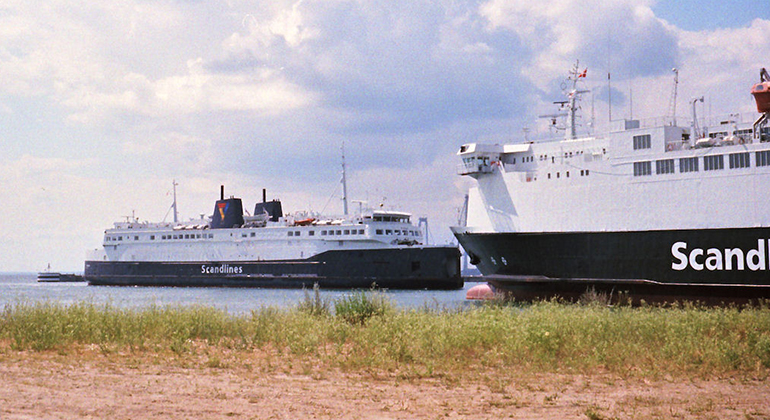
Scene for the Halsskov car ferry port back in July 1997. © Bernt Skjøtt
nov 02 2026

Related articles
Most read

Stena signs agreement to acquire Color Line
okt 26 2026
Arab Bridge Maritime acquires third RoPax from Europe in quick succession
okt 21 2026
Baleària to refurbish three ferries to improve comfort and onboard services
okt 19 2026
Funding secured for BESS capacity in Igoumenitsa Port
nov 01 2026
Spirit Quay opens in Devonport as SPIRIT OF TASMANIA I and II leave service
okt 26 2026
Philippine ferry capsizes right in front of its berth
okt 30 2026
ANALYSIS: Color Line is currently the larger operator in their shared market – both companies serve the same long corridor
okt 28 2026
TT-Line writes down Spirit of Tasmania ferries and terminals
okt 25 2026
Products