


Rolls-Royce completes mtu SCR line-up and gains DNV methanol-ready certificate
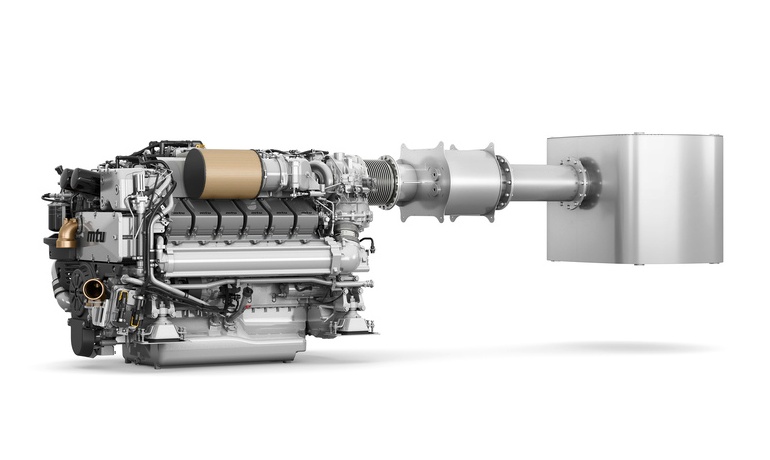
Rolls-Royce Power Systems has moved on two emissions fronts for its mtu marine engines, launching an integrated exhaust gas after-treatment system for the Series 2000 and securing a Methanol Readiness Certificate from classification society DNV for the current Series 4000.
The new after-treatment solution, being certified in collaboration with exhaust gas specialist Eminox, brings the Series 2000 into line with IMO Tier III standards and completes the company's portfolio for its key mtu marine propulsion systems. Selective catalytic reduction (SCR) allows offshore supply vessels, ferries, crew boats and patrol boats fitted with Series 2000 engines to operate without restriction in emission-controlled areas, among them the North Sea and the Baltic.
As in vehicle powertrains, an aqueous urea solution reacts with the nitrogen oxides in the exhaust gas and converts them into harmless substances, cutting NOx emissions by 75 per cent against IMO II limits. The integrated system is designed for a service life of up to 16,000 operating hours depending on load profile, needs no compressed air for dosing, and can be adapted to a range of ship designs.
"With this new offering, all models in the mtu Series 2000 are now available with integrated SCR systems. We have already launched a new, flexible and compact solution for the more powerful mtu Series 4000. This enables us to equip our customers with future-proof propulsion systems to meet the challenges of modern shipping," said Dr Lukas Köhler, Senior Vice President Global Marine & Mining at Rolls-Royce Power Systems.
Methanol retrofit path
The DNV certificate, meanwhile, confirms the technological concept under which newly built Rolls-Royce marine propulsion systems can later be retrofitted for dual-fuel operation on methanol — an answer, the manufacturer argues, to owners ordering tonnage against an uncertain regulatory horizon.
"The uncertain future of CO2 legislation is driving a growing desire among many ship operators for greater flexibility in terms of propulsion and fuel. With the methanol-ready certificate, we are giving our customers the assurance that they will be able to operate their ships on methanol in future, as soon as the fuel is sufficiently available," said Köhler.
Rolls-Royce tested the world's first high-speed marine engine running exclusively on methanol at its Friedrichshafen test bench in 2025, and has since logged and analysed more than 5,000 operating hours on the fuel in both single- and dual-fuel mode across several test benches. "These extensive findings form a strong foundation for our methanol retrofit concept," Köhler said, pointing to offshore vessels, ferries and mega yachts as the most promising applications. Burned green methanol produces significantly lower nitrogen oxide and particulate emissions than diesel and, assessed well-to-wake, a markedly lower CO2 footprint than fossil fuels.
The certificate is the latest step in a wider sustainable fuels programme. Rolls-Royce approved its key mtu engine series for hydrotreated vegetable oil (HVO) and other fuels to DIN EN 15940 as early as 2021, and this spring completed laboratory testing of the renewable synthetic fuel MATERA e-Diesel® with German e-fuel manufacturer INERATEC.
© Shippax
sep 01 2026

Most read
Stena Line confirms purchase of SOMERSET for Birkenhead–Dublin
okt 15 2026
Stena Line buys the SOMERSET for the Birkenhead – Dublin route
okt 12 2026
Oldest ferry in GNV’s fleet sold for recycling
okt 15 2026
DFDS’ new Baltic charter vessel leaves the Mediterranean
okt 16 2026
Baleària to refurbish three ferries to improve comfort and onboard services
okt 19 2026
World’s Largest wind-propelled RoRo now fitted with rotor sails
okt 15 2026
Steam Packet Company provides update on progress and costs of repairs to MANXMAN
okt 11 2026
Stora Enso signs up for Finnlines’ Green Lane low-carbon service
okt 15 2026
Products