


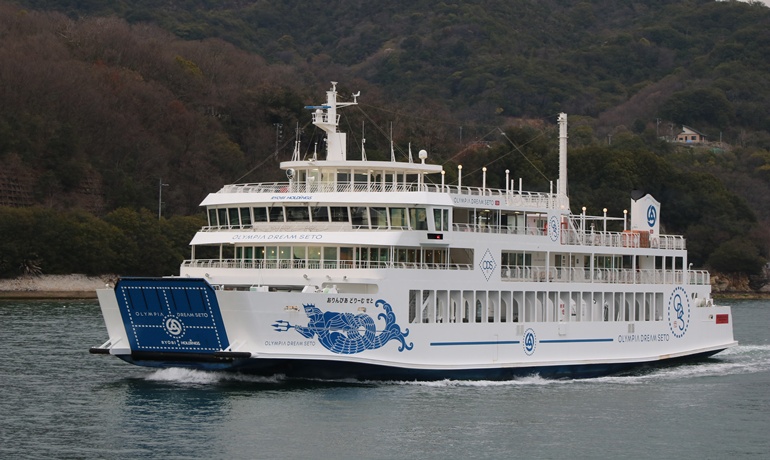
OLYMPIA DREAM SETO © Richard Seville
World's first fully autonomous passenger ferry launches commercial service in Japan
FerryThe passenger ferry OLYMPIA DREAM SETO has begun commercial operations on the Okayama-Shodoshima route, becoming the world's first regular service using Level 4-equivalent autonomous navigation – allowing fully automated voyages without human intervention in designated waters.
Operated by Ryobi Ferry Co., the 66-metre vessel, which carries up to 500 passengers between Shin-Okayama Port and Teshima Port in the busy Seto Inland Sea, passed Japan's national ship inspection on 5 December as the country's inaugural autonomous vessel. Its inaugural unmanned runs started 11 December, marking a leap forward in addressing Japan's acute crew shortages amid an ageing population and reducing human-error incidents on island routes.
The launch is the flagship achievement of the Nippon Foundation's MEGURI2040 project, initiated in February 2020 to automate 50% of Japan's coastal shipping by 2040. With over 400 inhabited islands dependent on ferries facing manpower crises, the initiative promises stable transport for residents and goods while promoting eco-friendly shifts from road to sea travel.
"This is a thrilling first step," said Mikihiro Umino, Executive Director of the Nippon Foundation. "By accumulating real-world examples, we'll refine operations for safer logistics and help shape global standards.
"Mitsunobu Kojima, CEO of Ryobi Holdings, echoed the sentiment: "Autonomous ferries herald a new era for maritime safety, slashing accidents and easing crew burdens. We're committed to driving widespread adoption.
"The OLYMPIA DREAM SETO underwent rigorous testing, including sensor validation and collision-avoidance systems, in the congested Seto Inland Sea. It builds on MEGURI2040's Phase 1 successes, such as unmanned voyages exceeding 750 km in challenging conditions like Tokyo Bay and Hokkaido routes.
Phase 2 of the project targets three more vessels for commercialisation this financial year: the coastal container ship MIKAGE (Kobe-Nagoya), the RoRo ferry HOKUREN MARU NO. 2 (Kushiro-Hitachi), and the container ship GENBU (Kobe-Osaka-Nagoya-Yokohama). Supported by land-based monitoring centres, these efforts leverage Japan's AI and ICT expertise to overcome longstanding hurdles in ship autonomy, including communication, obstacle detection, and costs.
As international bodies like the IMO deliberate on regulations – drawing parallels to automotive Level 4 standards – this Japanese innovation could redefine global seafaring, ensuring vital island lifelines endure for generations.
© Shippax
dec 11 2025

Related articles
Most read
Stena Line confirms purchase of SOMERSET for Birkenhead–Dublin
okt 15 2026
Stena Line buys the SOMERSET for the Birkenhead – Dublin route
okt 12 2026
Oldest ferry in GNV’s fleet sold for recycling
okt 15 2026
DFDS’ new Baltic charter vessel leaves the Mediterranean
okt 16 2026
Baleària to refurbish three ferries to improve comfort and onboard services
okt 19 2026
Steam Packet Company provides update on progress and costs of repairs to MANXMAN
okt 11 2026
World’s Largest wind-propelled RoRo now fitted with rotor sails
okt 15 2026
Stora Enso signs up for Finnlines’ Green Lane low-carbon service
okt 15 2026
Products