


Lifeboats can be unstable in some emergency scenarios
EU testing of six lifeboats for stability showed that some are at risk of becoming flooded when not fully loaded and passengers are all seated on one side. This was the outcome of a testing campaign organised by the European Commission’s Directorate-General for Internal Market, Industry, Entrepreneurship and SMEs (DG GROW).
All boats had sufficient stability when fully loaded, or when lightly crewed if used as a rescue boat to recover a casualty from the water.
However, when two of the boats were 50 % full and all people were seated on one side, the boat tilted (heeled) too much, which could cause water to flood through the hatch openings. This was the case when each passenger had a weight of 82.5 kg.
When the test was repeated, but each passenger's weight was reduced to 75 kg, one boat failed to meet the stability requirement of having sufficient distance between the opening and the waterline (freeboard).
A large heeling angle and a freeboard of less than 12 cm (for the size of the lifeboat as tested) presents a risk of the boat being flooded, particularly in rough seas.
Four lifeboats had a heeling angle significantly greater than 20° irrespective of freeboard. For passenger vessels, the heeling angle may not be greater than 7° for a full probability of survival. Greater heeling angles may well cause panic and this should be considered when judging the lifeboat's stability.
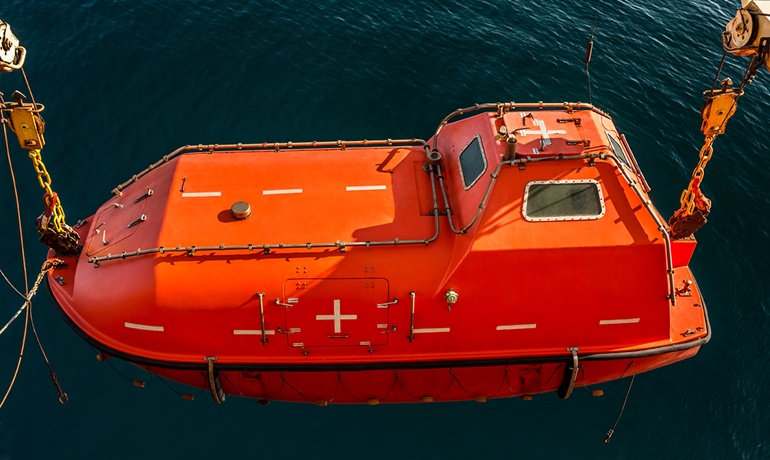
Partially and fully-enclosed lifeboats
The aim of the tests was to determine to what extent the current regulation, the International Life Saving Appliance Code (LSA), ensures sufficient stability for lifeboats to be safe in practical circumstances. Although most of the boats passed, the testing raised the question of whether LSA requirements are robust enough.
A total of six lifeboats from five manufacturers were tested. They were partially and fully-enclosed models with a passenger capacity of between 60 and 80 people.
Market surveillance authorities from Germany, Latvia, Italy, Finland, Portugal, Ireland and Sweden were involved in the testing.
Stability was assessed under several conditions: empty, fully loaded, loaded with half the maximum passenger complement all seated on one side, and during a casualty rescue scenario with five crew.
Reported lifeboat incidents are rare
Market surveillance authorities noted that reported incidents related to lifeboat safety are rare, however the risks should not be overlooked.
The LSA code currently does not set stability requirements for situations where people are standing and moving around in the boat, as in rescue boat operations.
Market surveillance authorities recommended that further stability checks be done on a larger sample of boats and that testing includes situations where passengers are standing, instead of sitting, to reflect human behaviour in an emergency.
MSAs will contact the International Maritime Organization, presenting the project's findings and recommending a review of the current LSA to ensure lifeboat stability in realistic conditions.
Training exercise
Interest in testing lifeboats followed an incident during a training exercise with a fully-enclosed lifeboat in Frihamnen harbour, Sweden on 12 April 2021. As participants were being pulled from the water into the boat, it listed heavily and water flooded in through an open hatch. Three of the seven crew fell into the water. An official investigation found that although the boat complied with international stability requirements, it could be unstable when lightly loaded and with open hatches.
Research done on this incident found that lifeboat stability decreases as passenger numbers decrease and is compromised when people are standing or moving around.
JACOP 2024
"Market surveillance campaigns like this are vital to protect the health and safety of consumers and to support fair competition for businesses in the Single Market," said Vanessa Capurso, Policy Officer at DG GROW.
The tests were done during the Joint Actions on Compliance of Products (JACOP) 2024 project, across the EU and EFTA countries. Such initiatives help ensure a safe Single Market by strengthening cooperation between market surveillance authorities. They jointly test products, determine their risks and harmonise ways of working. Lifeboats were one of 16 product categories tested.
apr 01 2026

Most read
Stena Line confirms purchase of SOMERSET for Birkenhead–Dublin
okt 15 2026
Stena Line buys the SOMERSET for the Birkenhead – Dublin route
okt 12 2026
Oldest ferry in GNV’s fleet sold for recycling
okt 15 2026
DFDS’ new Baltic charter vessel leaves the Mediterranean
okt 16 2026
NEW GOLDEN BRIDGE IX joins Weidong Ferry fleet
okt 09 2026
LAKEWAY EXPRESS joins Wallenius SOL
okt 09 2026
Polaris Autoliners gains financing for fleet expansion
okt 09 2026
Baleària to refurbish three ferries to improve comfort and onboard services
okt 19 2026
Products