



Innovations on the TEXELSTROOM
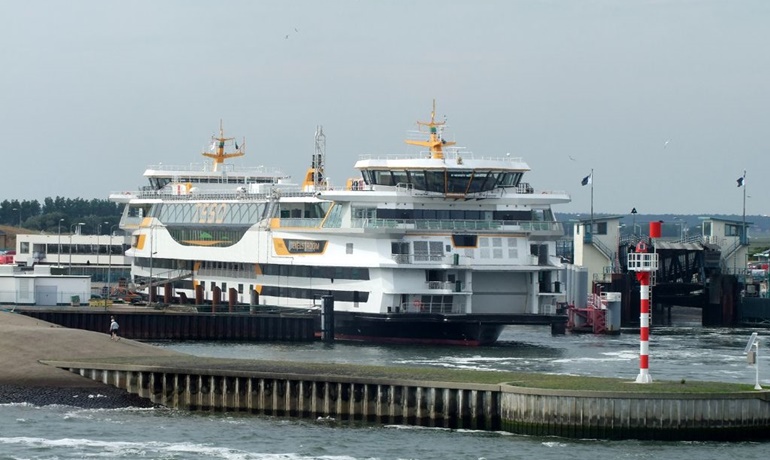
Everybody is looking forward to see the modern ferry TEXELSTROOM entering service. (see previous news). The ferry is a highly advanced vessel with several innovative solutions designed by C-Job Naval Architects in cooperation with TESO. An overview.
Dual-fuel hybrid propulsion system
To maximise sustainability, the TEXELSTROOM is equipped with a dual-fuel hybrid propulsion system. Two of the four generators run on compressed natural gas (CNG) which minimize the emission of NOx, SOx and fine particles (soot). Further to that, the emission of the green-house gas CO2 is reduced significantly. The generated electricity, which is required for the propulsion by the azimuth thrusters, will be buffered in two large battery banks. This enables the TEXELSTROOM to run in normal conditions on just one generator, while the batteries provide additional power during acceleration from the harbour. The generator provides a constant power at optimal load which makes the engine very efficient.
Car capacity increase by the T-shaped section
To comply with the request to increase the car capacity, the TEXELSTROOM is increased in beam on the upper car deck level. This enables the ship to carry 14% more cars on 2 additional lanes on the upper car deck. At the lower car deck, the ship has its original beam to fit in the existing berths. As a result of the increase beam, also the saloon situated above the upper car deck, has additional space for the passengers.
Thermal water buffer tank
During the day, the cooling water of the generator(s) is heating a thermal water buffer tank. This buffer tank of about 80 cubic meters is filled with fresh water, which is heated by a heat exchanger from the engines. During the night, when this TEXELSTROOM is off duty, the ships saloon and public spaces are heated by the hot water from the buffer tank. This solution saves fuel on a boiler which would normally heat the ship during the night.
Wind drag reduction
C-Job executed Computational Fluid Dynamic (CFD) calculations on the TEXELSTROOM to lower the drag on the vessel. For this purpose, the outer corners at the ships ends, in way of the car and bicycle decks are chamfered. Also the wheelhouse is lowered compared to the DOKTER WAGEMAKER. By streamlining the vessel above the waterline, fuel consumption is lowered.
Hull form optimization
CFD calculation and tank tests have been performed on the hull to optimize the shape for hydrodynamic resistance. As a result, the fuel consumption is lowered.
Car deck ventilation
CFD analyses have been performed to improve the flow of air on the car decks. This study was done to avoid dead zones on the car deck where toxic gasses may collect and to improve the efficiency of the fans is improved and fuel is saved.
Solar panels
The upper deck is equipped with solar panels to generate as much as possible renewable energy.
jul 22 2016

Most read
(Video) Fire breaks out on GNV PHOENIX in the Port of Naples during maintenance
maj 28 2026
BC Ferries unveils Summit Class as fleet renewal accelerates
maj 28 2026
Estonian State Fleet signs contract with CRIST S.A. to build Estonia’s first fully electric ferry
maj 22 2026

Heavy lift vessel bound for Hobart to collect hull 096
jun 01 2026
FRS introduces emission-free electric ferry to island connection in Finland
maj 26 2026

Fred Olsen steps down as Bonheur chairman after seven decades
maj 28 2026
CLdN moves shipping operations to the UK and welcomes Maritime Minister to London terminal
maj 23 2026
SPIRIT OF 1733 has entered service in the U.S. Virgin Islands
maj 23 2026
Products