


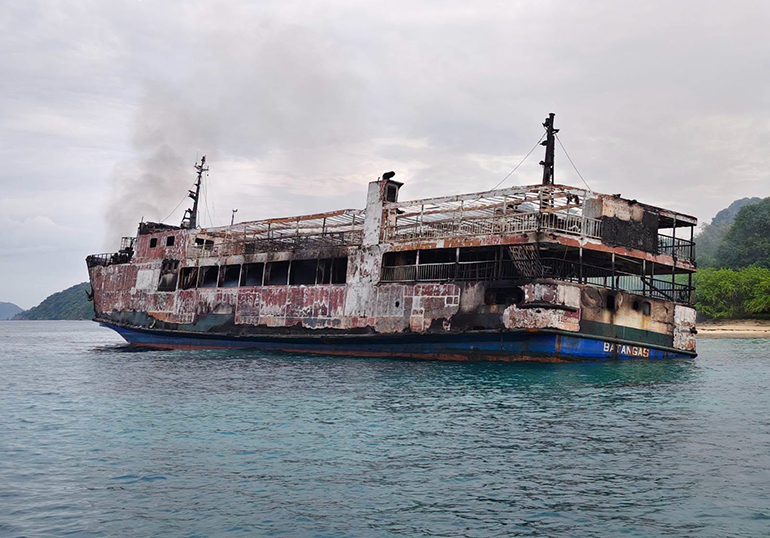
The wreckage of JUNE ASTER © Philippine Coast Guard
Ban of electric vehicles in the wake of the JUNE ASTER disaster
FerrySo far, two regional ferry operators in the Philippines have introduced temporary bans on electric and hybrid vehicles (EVs and HEVs) aboard their ferries. The measures follow the fire disaster aboard the ferry JUNE ASTER on 9 September, in which at least 77 people lost their lives.
Montenegro Shipping Lines and Starhorse Shipping Lines have both introduced temporary bans on the carriage of these two types of vehicles.
In a statement published 18 September, Starhorse Shipping Lines writes the following:
“The batteries used in today’s electric and hybrid vehicles present risks that domestic RoRo service is not yet equipped to manage. On our ships, vehicles travel in enclosed or semi-enclosed decks, often with passengers above them, on long inter-island passages. A lithium battery fire can enter thermal runaway, is difficult to cool and contain with the firefighting systems now fitted on our vessels and may reignite after it appears to have been put out. Present national rules do not yet set a clear standard for this kind of carriage. Until those rules are in place, and until we are satisfied that these vehicles can be carried without placing the riding public at undue risk, we will not accept that exposure. Effective immediately, and until further notice, Starhorse Shipping Lines will not accept electric vehicles or hybrid vehicles for boarding or carriage on any vessel in our fleet.”
Montenegro Shipping Lines issued a similar notice to its customers on 16 September. JUNE ASTER was operated by a third regional Philippine ferry operator, Atienza InterIsland Ferries. The company has issued several statements in the wake of the ferry disaster, but none so far concerning the carriage of electric vehicles.
No casualty investigation report has yet been published that sheds light on the cause of the intense fire aboard JUNE ASTER. Survivors who have spoken to Philippine media have, among other things, described hearing explosions from the vehicle deck during the initial stage of the fire. According to the Philippine authorities, JUNE ASTER’s vehicle deck carried one electric car, one conventionally powered car, five motorcycles and a forklift.
Worldwide, attention has focused on the risk of fires involving the lithium-ion battery packs of electric vehicles when they are carried on the vehicle decks of passenger ferries. However, all available experience with electric cars indicates that they are less likely to catch fire than conventionally powered cars.
Nevertheless, tackling a fire in an electric car’s lithium-ion battery requires entirely different firefighting strategies from those used for a petrol- or diesel-fuelled fire.
Until now, Havila Kystruten, which operates four coastal passenger ships on the world-famous Norwegian coastal route between Bergen and Kirkenes, has been the only operator to ban the carriage of electric cars. However, the financial consequences of not carrying electric cars are minimal for Havila Kystruten, as its four side-loading coastal passenger ships derive most of their revenue from cruise passengers and can carry only a very small number of vehicles.
Read also: Death toll rises sharply following Philippine ferry fire
© Shippax
sep 21 2026

Related articles
Most read
Dieppe–Newhaven route put out to tender for new five-year concession
okt 08 2026
Stena Line confirms purchase of SOMERSET for Birkenhead–Dublin
okt 15 2026
Gibraltar acquisition finally approved – but DFDS withdraws from Ceuta opportunity
okt 08 2026
MARHABA SEAWAYS joins DFDS fleet
okt 08 2026
Stena Line buys the SOMERSET for the Birkenhead – Dublin route
okt 12 2026
Oldest ferry in GNV’s fleet sold for recycling
okt 15 2026
MAXINE chartered by Smyril Line
okt 08 2026
DFDS’ new Baltic charter vessel leaves the Mediterranean
okt 16 2026
Products