


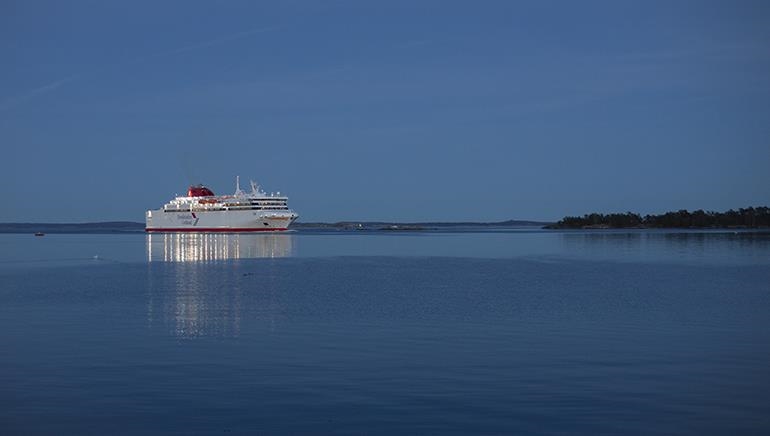
VISBY arrives in Nynäshamn from Gotland. © Søren Lund Hviid
Research project combines climate transition with greater preparedness in the Baltic Sea
FerryHow can tomorrow’s RoPax vessels become more climate-friendly while strengthening their role in Sweden’s emergency preparedness? Gotland Tech Development, RISE and Wärtsilä will explore this question in NORDAN, a three-year research collaboration partly funded by the Swedish Energy Agency.
NORDAN will explore future ship concepts for RoPax operations in Swedish and Nordic waters. The project runs until September 2029 with a budget of SEK 7.3 million, of which the Swedish Energy Agency is contributing SEK 4.4 million.
The agency considers that the project could help make RoPax vessels more energy-efficient, benefiting several Swedish and European stakeholders.
“We want to give ourselves the scope to be ambitious and thoroughly explore the design possibilities for new concepts that combine a low climate footprint with greater preparedness in RoPax shipping in Swedish waters,” says Mikael Razola, Head of Gotland Tech Development.
In NORDAN, Gotlandsbolaget defines the operational requirements and contributes its experience of operating ferry services across the Baltic Sea, while RISE tests and evaluates the ideas, including at its globally unique SSPA Maritime Centre test facilities.
By combining wind propulsion with new propulsion technology, the researchers hope to develop concepts that drastically reduce a RoPax vessel’s energy consumption.
“We are looking at the vessel’s key components: hull form, propulsion technology, new fuels and energy carriers,” says Sofia Werner, a naval architect and researcher in marine hydrodynamics at RISE.
What distinguishes NORDAN from previous climate projects is that it also takes Sweden’s security situation in the Baltic Sea into account. A vessel concept must be climate-friendly while also being capable of maintaining supplies to society during a crisis – a so-called dual-use solution.
“Previously, we mainly looked at climate performance. Now, the choice of fuels and energy carriers also becomes a question of resilience,” says Sofia Werner.
Within three years, the project will have developed a proposed vessel concept with calculated climate performance. This could serve as a source of knowledge and a starting point for actual vessel orders, both for the project partners and for the wider shipping industry.
The NORDAN team secured funding in competition with other applicants, and work formally began on 1 September.
“NORDAN gives us the opportunity to broaden our network and explore areas that lie a little further into the future. It is also very rewarding to work with RISE, which is among the world’s leading organisations in this field,” says Mikael Razola.
© Shippax
okt 01 2026

Related articles
Most read
Dieppe–Newhaven route put out to tender for new five-year concession
okt 08 2026
Stena Line confirms purchase of SOMERSET for Birkenhead–Dublin
okt 15 2026
Gibraltar acquisition finally approved – but DFDS withdraws from Ceuta opportunity
okt 08 2026
MARHABA SEAWAYS joins DFDS fleet
okt 08 2026
Stena Line buys the SOMERSET for the Birkenhead – Dublin route
okt 12 2026
Oldest ferry in GNV’s fleet sold for recycling
okt 15 2026
MAXINE chartered by Smyril Line
okt 08 2026
DFDS’ new Baltic charter vessel leaves the Mediterranean
okt 16 2026
Products