


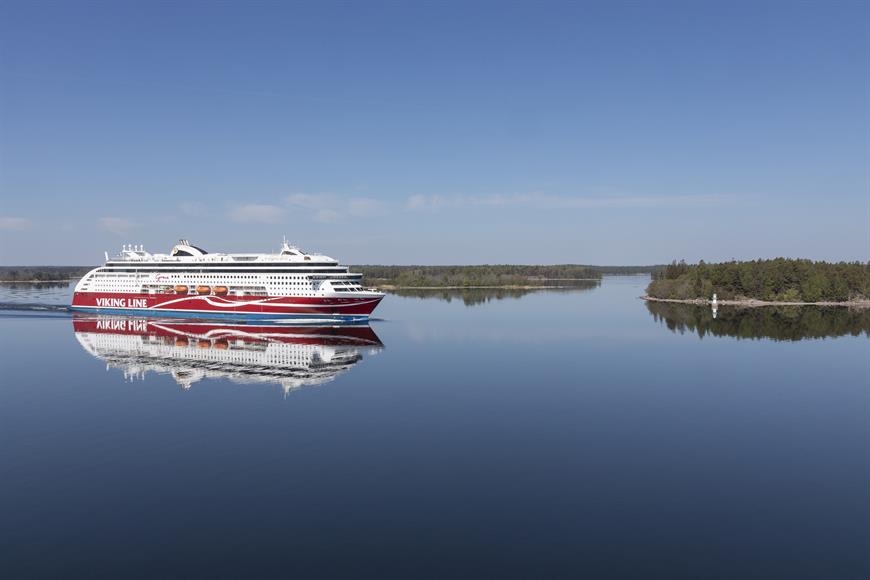
VIKING GRACE © Søren Lund Hviid
Energy costs weigh on Viking Line’s summer quarter
FinanceViking Line reported a net profit of EUR 25.1 million for the third quarter of 2026, down from EUR 29.3 million in the same quarter last year, as persistently high energy prices offset stable peak-season demand. Sales amounted to EUR 154.9 million, up 1.6% from EUR 152.5 million in Q3 2025, while operating income fell to EUR 25.5 million from EUR 28.7 million.
Key points:
- Q3 2026 net profit of EUR 25.1 million, down 14.3% from EUR 29.3 million in Q3 2025
- Q3 sales up 1.6% to EUR 154.9 million (EUR 152.5 million); operating income down to EUR 25.5 million (EUR 28.7 million)
- Q3 fuel and emission allowance costs rose to EUR 21.8 million (EUR 14.8 million); operating expenses up 7.1%
- Q3 cargo revenue up 12.2% to EUR 13.2 million; passenger revenue up 0.7% to EUR 141.3 million
- Nine-month sales flat at EUR 368.9 million (EUR 368.3 million); income after taxes almost halved to EUR 6.4 million (EUR 12.0 million)
- Passengers at 3,557,522 (3,576,893) and cargo units at 100,719 (104,666) for January–September
The main pressure came from fuel and emission allowance costs, which rose to EUR 21.8 million in the quarter, compared with EUR 14.8 million a year earlier. Total operating expenses increased by 7.1% to EUR 91.0 million. Earnings from associated companies and joint ventures also weakened, with the share of results falling to EUR 2.7 million from EUR 4.3 million.
On the revenue side, passenger-related revenue edged up 0.7% to EUR 141.3 million, while cargo revenue jumped 12.2% to EUR 13.2 million compared with Q3 2025.
President and CEO Marcus Risberg described the quarter as one of stable peak-season demand, with passenger volumes in line with last year, and noted positive developments in international travel and vehicle passengers.
Nine-month result halved
For January–September, sales were virtually unchanged at EUR 368.9 million (EUR 368.3 million), but income before taxes fell to EUR 8.4 million from EUR 14.4 million, and income after taxes to EUR 6.4 million from EUR 12.0 million. Fuel and emission allowance costs for the period totalled EUR 51.9 million, against EUR 45.0 million a year earlier.
Passengers on the group’s wholly owned vessels totalled 3,557,522, compared with 3,576,893, while the estimated overall market share rose slightly to 32.4% from 32.2%. BIRKA GOTLAND carried 411,563 passengers (417,369).
Volumes grew between Finland and Estonia, where market share reached 25.0% (24.5%), but traffic between Finland, Åland and Sweden declined amid tougher competition, with Viking Line’s share slipping to 58.7% from 59.9%. Cargo volumes fell to 100,719 units from 104,666, although freight revenue improved thanks to higher average revenue per cargo unit.
Fleet and TT-Line cooperation
VIKING GRACE was docked from 6 January to 28 January, accounting for most of the period’s EUR 14.8 million investment. Over the summer, GABRIELLA and VIKING CINDERELLA called at Tallinn from 17 June to 9 August as part of the Helsinki–Mariehamn–Stockholm service, and also operated destination cruises from Helsinki to Visby.
After the reporting period, Viking Line entered into a cooperation agreement with TT-Line on the Helsinki–Muuga route, with operations scheduled to start in the first quarter of 2027. Risberg called the move a strategic step to strengthen the company’s freight market position.
Outlook lowered
Citing continued high energy prices, the Board now expects 2026 income before taxes to be below previous expectations and significantly lower than in 2025.
© Shippax
okt 22 2026

Related articles
Most read
Dieppe–Newhaven route put out to tender for new five-year concession
okt 08 2026
Stena Line confirms purchase of SOMERSET for Birkenhead–Dublin
okt 15 2026
Gibraltar acquisition finally approved – but DFDS withdraws from Ceuta opportunity
okt 08 2026
MARHABA SEAWAYS joins DFDS fleet
okt 08 2026
Stena Line buys the SOMERSET for the Birkenhead – Dublin route
okt 12 2026
Oldest ferry in GNV’s fleet sold for recycling
okt 15 2026
MAXINE chartered by Smyril Line
okt 08 2026
DFDS’ new Baltic charter vessel leaves the Mediterranean
okt 16 2026
Products